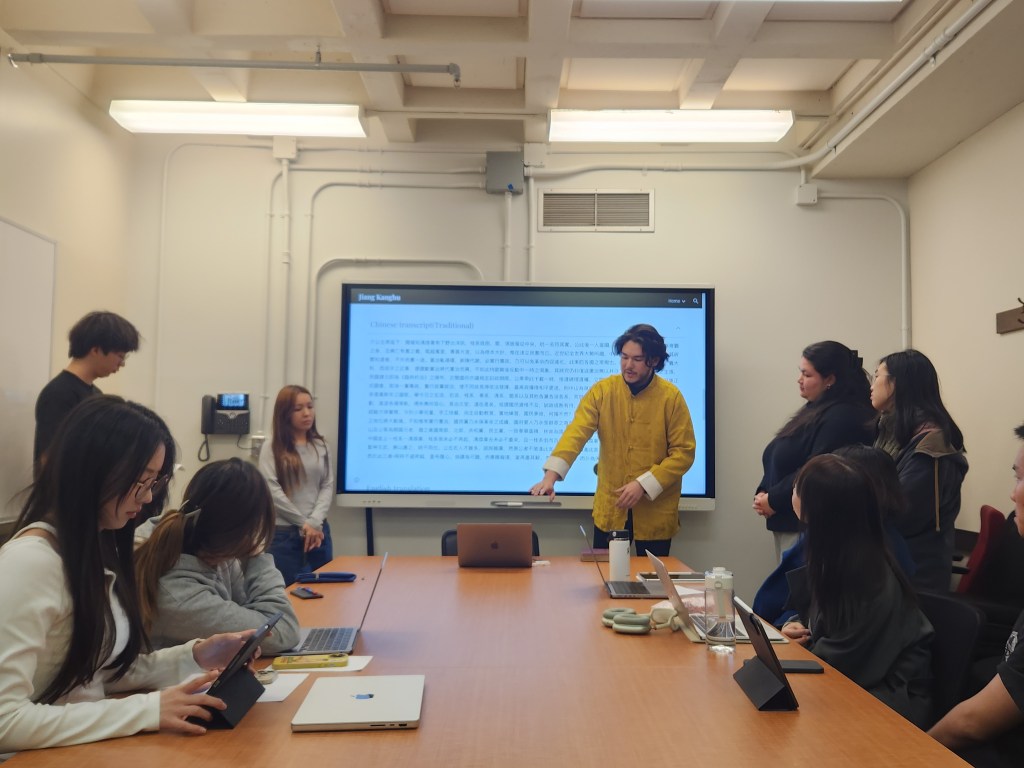
In the fall semester of 2024, I taught Classical Chinese at McGill. It was a small class—just 13 undergraduates—but with a wonderful mix of students from around the world, including China, the U.S., Canada, and Europe. We used Michael Fuller’s textbook as our guide to ancient Chinese texts.
For their final projects, students worked on translating texts written in Classical Chinese from the late imperial and modern periods. These translations were exercises—certainly not ready for publication and undoubtedly in need of revision—but I was thoroughly impressed by the students’ passion and dedication. When given the right guidance, they achieved remarkable progress in such a short time.
The first project focuses on Jiang Kanghu 江亢虎 (Kiang Kang-hu, 1883–1954), who founded the Chinese Department at McGill and taught here from 1930 to 1934. Although he was a prominent thinker and social activist in modern China, his legacy has largely faded into obscurity due to his involvement with the Wang Jingwei government during the Sino-Japanese War. My students concentrated on Jiang’s time at McGill, examining his global connections by analyzing selected letters.
The second project explores the use of Classical Chinese in Montreal’s Chinatown and the more recently developed area near Concordia University. Although we hoped to locate letters written by Chinese immigrants in Montreal, our search was unsuccessful. Nevertheless, the two students working on this project assembled an impressive corpus of materials, uncovering a wealth of topics ripe for further exploration. Their work provides a valuable foundation for future research on the linguistic and cultural history of Montreal’s Chinese community.
The final two projects focus on translations of women writers from Qing-dynasty China. One group worked on selected writings by Xu Yezhao 徐葉昭 (1729–1794), while another student translated the poetry of Yun Zhu 惲珠 (1771–1833). I was deeply impressed by their ability to read and interpret these classical texts. In fact, I was genuinely shocked to learn that one of the students—who grew up in Canada—had never taken a formal Chinese class before.
I would like to especially acknowledge the invaluable assistance of Ms. Hye-jin Juhn, Librarian for East Asian Studies at McGill University. The projects involved in-depth research on premodern Chinese literature and Asian American history. Ms. Juhn not only hosted a workshop on using databases for the class but also created a resource guide for EAST 533: Classical Chinese. Her unwavering support has been indispensable to these and other projects undertaken by my students.
I am also grateful to Ms. Heather McNabb, who helped my students arrange a visit to view selections from the McCord Museum’s collections on Chinese immigrants in Montreal.
This course has been a successful and memorable experiment. I plan to offer it every year and try out new things with different groups of students.
When I teach Chinese drama, I almost always give students the options of writing a paper or perform in a play. I have consistently realized that most students prefer to perform onstage: it is fun, it is memorable, and it is a special college experience.
It took me a while to get used to the McGill way of naming semesters––the fall semester (Sept-Dec) followed by the winter semester (Jan-April). No, there is no spring, not before the regular semester ends. I was not sure if I could find a venue and if the McGill students would be able to pull off a performance event in a number of weeks. With advice from colleagues (esp. Dr. Erin Hurley from English) and support from the Tuesday Night Cafe theater, we did it!
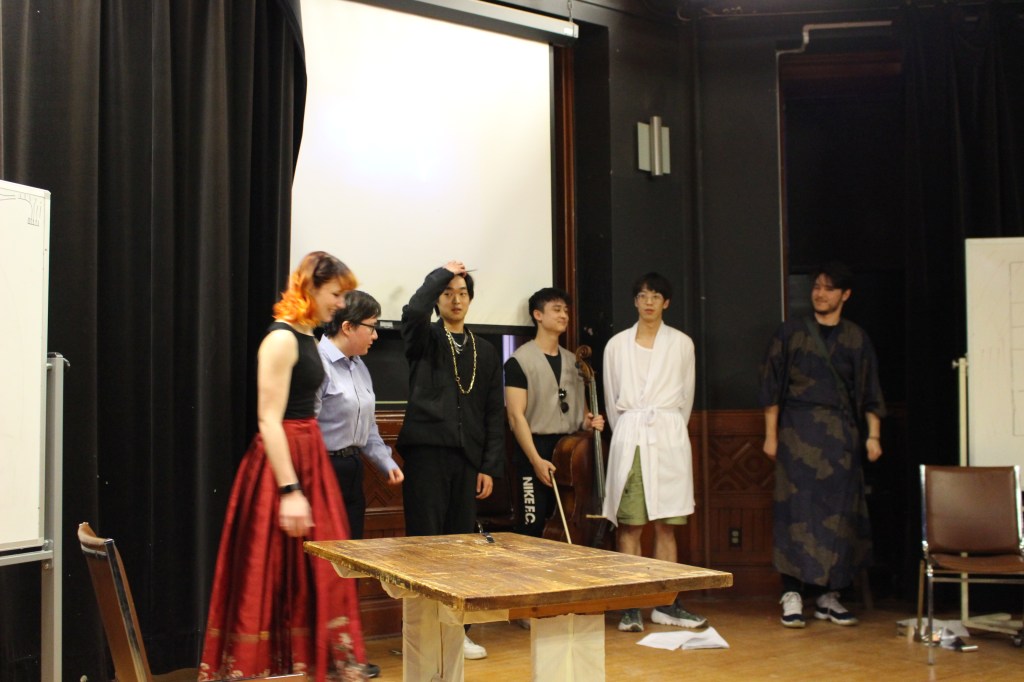
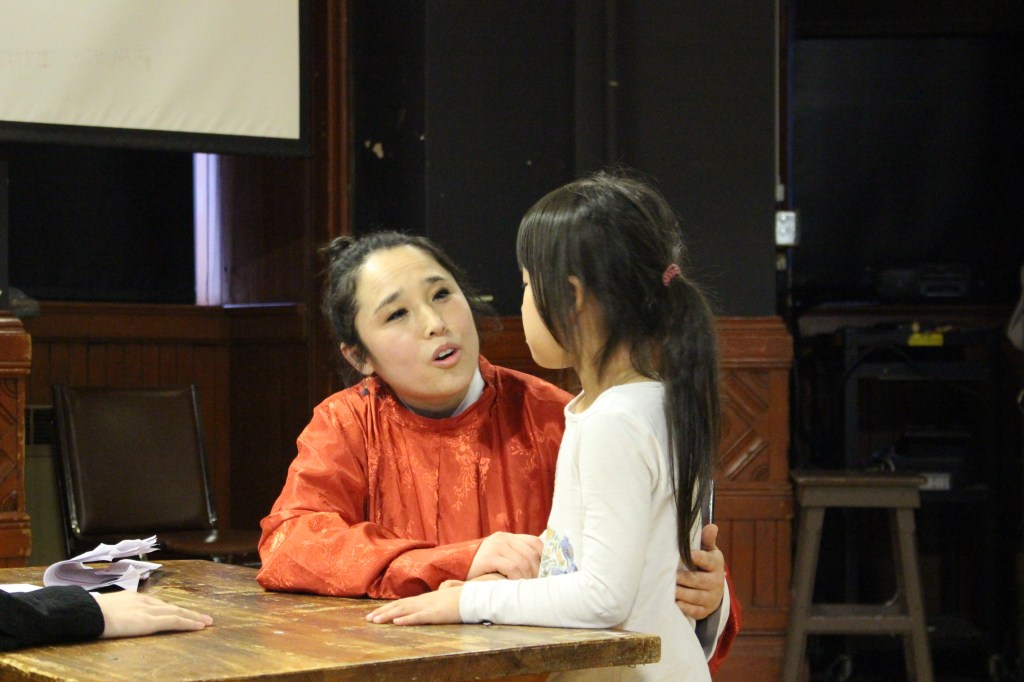
We had $0 budget, so students had to improvise. Some cut up sheets for costumes; others brought their musician friends (and a child) as guest actors. I was thoroughly impressed by the creativity of McGill students. I was indeed a memorable spring, one of many yet to come.
Below is a brief summary of the program done by a student in the class.
Exploring Chinese Dramas: A Night of Adaptation and Entertainment
by Katherine Marchand
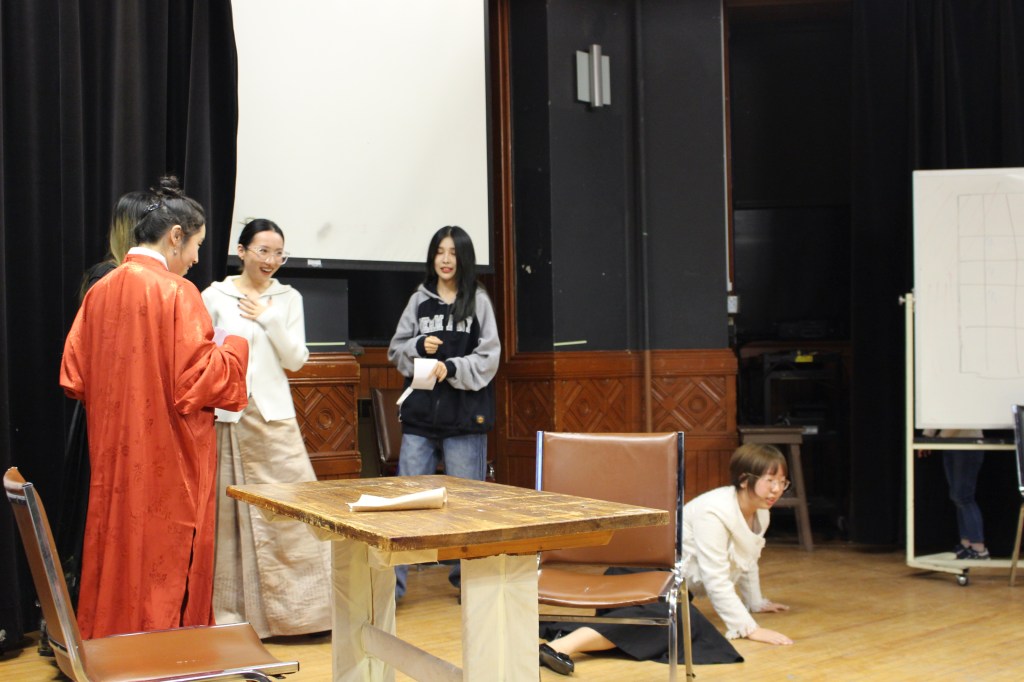
On Monday, April 8, 2024, the Morrice Hall Tuesday Night Cafe Theater witnessed an enchanting exhibition of Chinese drama adaptations presented by students from McGill University enrolled in the EAST 303 Chinese Drama: 13th to 20th Centuries course. Five captivating performances, each offering a unique interpretation of classical Chinese dramas, allured the audience and provided insight into the diverse landscape of Chinese theatrical tradition.
The evening began with a rendition of The Butterfly Lovers, performed by Grace van Bever, Lydia Zheng, Brandon Sun, Lukas Lorenz, and Haohan Li. Originating from the Tang dynasty, although set in the Eastern Jin, the tale highlights the forbidden love between Liang Shanbo, a young scholar, and Zhu Yingtai, a wealthy woman disguised as a man to seek education. Their strong affinity, which first blossomed while studying together but turned into love upon Liang visiting Zhu at her home, reveals societal and familial expectations as Zhu is forced into an arranged marriage. As a result, this then leads Liang to die of a broken heart. However, their love proves to be stronger than these imposed barriers since, in death, as Zhu commits suicide to join the scholar, their spirits transform into a pair of butterflies that are forever united in the afterlife. Overall, with the addition and apparition of a prophet monk, who claims that Zhu is a vessel of immortality whose actions transcend the laws of the mortal realm. The students’ performance was adapted with a comedic modern flair to capture the essence of the original narrative while still infusing it with contemporary elements and humor.
Following this opening act, an adaptation of The Injustice to Dou E was presented by Carolyn Liu, Xinxin Lian, Yuanzhen Shao, Yvette Ran, and Juan Zhang. This rendition drew inspiration from Zhang Maozun’s reinterpretation of Dou E and centered on the portrayal of Zhang as a Ming scholar. Going back in time to the Yuan dynasty after accidentally ingesting an excessive amount of magic mushrooms, Zhang observes a local performing troupe preparing for a Dou E play. The scholar is depicted perplexedly observing the rehearsal while attempting to align the script’s lines with his own beliefs and values. Despite the performance’s focus on the humorous yet intriguing interactions between the scholar and the troupe, it shed light on the intricate themes of loyalty, injustice, societal corruption, sacrifice, and vengeance inherent in the original 13th-century play.
The third act, The Orphan of Zhao, was adapted with a comedic modern approach by Akassia Molina, Thomas Coleman, and François-Xavier Chapdelaine Perreault. The zaju play follows the narrative of Zhao Dun, a nobleman falsely accused of treason, and explores the themes of loyalty, sacrifice, and vengeance. In order to preserve his family’s honour, Zhao secretly entrusted his newborn son to Cheng Ying, a devoted servant, before sacrificing himself. Upon learning the truth about his lineage, Cheng Bo, the orphan raised under Cheng’s care, resolves to seek retribution for his family’s demise. Altogether, despite the complexity of the original plot, the students skillfully intertwined traditional elements with creative ideas and accessories, engaging with and transporting the audience to ancient China. As the night progressed and transitioned to the early 20th century, the audience was treated to an interpretation of Chen Kaige’s film Farewell My Concubine, performed by Ella Yu,
Shelley Zhong, and Yanou Li. While the play covers several decades and events, including the Japanese invasion and the Cultural Revolution, it follows the lives of Douzi and Shitou, two performers trained at an all-boys Peking opera troupe from a young age. As the play unfolds, their professional and personal lives become entwined with the themes of love, loyalty, sacrifice, and political turmoil. With meticulous attention to detail, the performance wonderfully expressed the emotions and focal points behind the plot, leaving a lasting impression on the spectators.
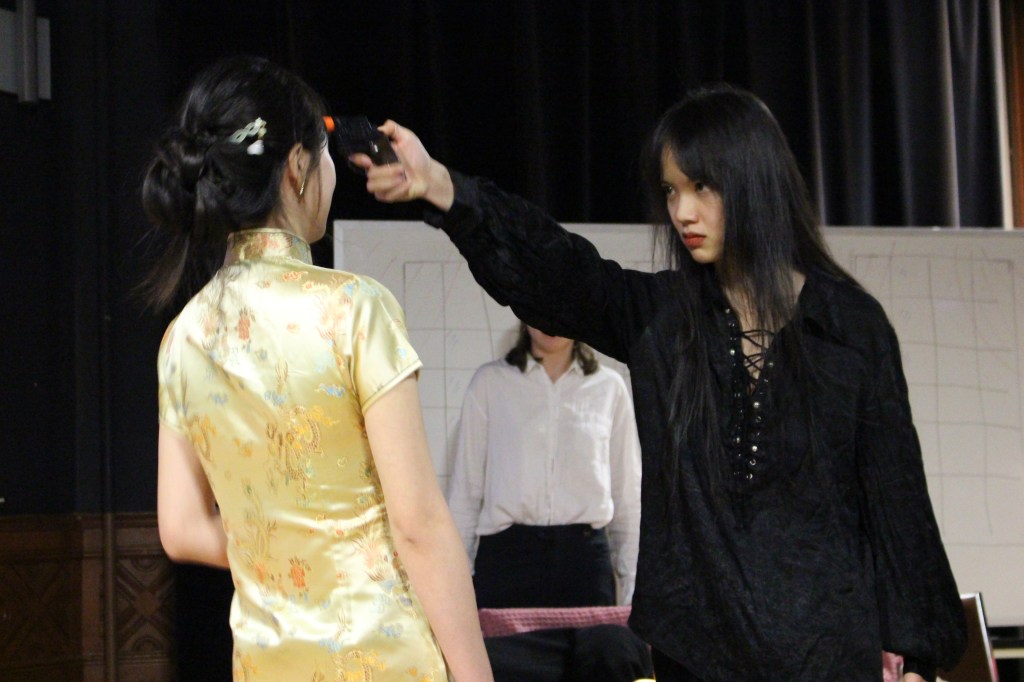
The evening came to an end with an adaptation of Cao Yu’s Thunderstorm, a creative work of modern Chinese drama, also known as huaju. Performed by Yupeng Wang, Meifan Qian, Yilin Liu, Atlas Yanovsky, Keva Misata, Morgan MacEachern, Wyn Lumley, Ziteng Yin, Susan Huang, Ian Zou, and Jasmine Wang, the students exposed the dark secrets of dysfunctionality, betrayal, and illicit affairs revolving around the Zhou family. While focusing on the play’s fourth act, the performance not only revealed the tragic consequences of the characters’ actions from the original play but introduced new and shocking repercussions, including the emergence of new relationships and the demise of several characters. Through the creative staging and compelling character portrayals, in addition to a ghost narrator, the adaptation brought a fresh and new perspective into this timeless classic, eliciting profound emotions and laughter from the audience.
Each performance showcased at the Morrice Hall Tuesday Night Cafe Theater underscored Chinese drama’s lasting significance and broad appeal. By reimagining the narratives of The Butterfly Lovers, The Injustice to Dou E, The Orphan of Zhao, Farewell My Concubine, and Thunderstorm for a contemporary audience, the students not only demonstrated their creativity and talent but also sparked meaningful conversations about tradition and innovation.
Undoubtedly, the event was more than a display of theatrical ability; it was a vibrant celebration of artistic expression and cultural heritage. Through their adaptations, the students of EAST 303 Chinese Drama: 13th to 20th Centuries took the audience on a fascinating journey through time and tradition, leaving a memorable impression on those fortunate enough to attend.
The class happens to include 23 students many of whom are first-year international students. For the final project, we explored the Asian students who came to Vanderbilt University for an education from 1873 to 1923, the first 50 years of Vanderbilt’s history. We have discovered amazing adventures, tragic stories, and thought-provoking life choices in times of national conflict.
This has been a unique course and unique experience. I have witnessed significant and occasionally worrisome changes in the south of America during my eight years as a faculty member at Vanderbilt University. Stories of VU’s Asian alumni from 100 years ago shockingly resemble our experiences in modern-day America. I hope students have found my course helpful for them to understand history and navigate today’s troubled world.
The class of Romancing the Nation in Modern Chinese Literature (2021 fall) created a few sites revolving around the themes of love, marriage, labor, migration, and redness.
2020 was a chaotic year in America, with the presidential election, the pandemic, and so on. I designed and offered a new course titled Overseas Encounters: Reading the World through Students Abroad. We read and discussed the history and literature about international students in the world from the seventh century China to the 21st century America. We also explores themes related to those experiences: religion, culture, gender, language, etc. Below are some projects my students created to document their discoveries.
The Legend of the Red Lantern is one of the eight modern operas during the Cultural Revolution (1966-1976). It was based on movies and novels produced in the preceding decades. It was a work of art as well as propaganda for decades in contemporary China. The episode performed by Isaiah Degen features the interrogation of a Communist army member by a Japanese military official. Isaiah innovatively plays both roles by himself.
Peony Pavilion is a Chinese opera composed by Tang Xianzu (1550-1616). It is often compared with Romeo and Juliet due to their shared themes of love and death. After discussing part of the drama with a focus on the protagonist Bridal Du’s death caused by lovesickness, a group of students came up with their own ways to dress up and read/perform the encountering in dream between Bridal Du, her lover Student Liu, at the presence of a God of Flowers.
The Orphan of Zhao is a canon in the repertoire of classical Chinese drama. Composed by Ji Junxiang during the 13th century, it is arguably the best “tragedy” in premodern China. It was also the first Chinese drama ever translated into European languages.
During the spring semester of 2020, a group of students in US and Asia collectively produced this play on the platform of Zoom. Because most of the could not meet in person, they made the best use of the online platform to present a virtual version of the ancient historical play.
The Injustice to Dou E is a Chinese opera written by Guan Hanqing during the Yuan dynasty (1279-1368). the story is about a widow who is wrongfully accused of murdering her father-in-law. The original play was composed for performance with dialogues and arias. A group of students produced an animated version of this play during fall 2020. Because of the pandemic, many of the students could not meet in person so they communicated online and completed this amazing project.






 GUOJUN WANG