
When I teach Chinese drama, I almost always give students the options of writing a paper or perform in a play. I have consistently realized that most students prefer to perform onstage: it is fun, it is memorable, and it is a special college experience.
It took me a while to get used to the McGill way of naming semesters––the fall semester (Sept-Dec) followed by the winter semester (Jan-April). No, there is no spring, not before the regular semester ends. I was not sure if I could find a venue and if the McGill students would be able to pull off a performance event in a number of weeks. With advice from colleagues (esp. Dr. Erin Hurley from English) and support from the Tuesday Night Cafe theater, we did it!
We had $0 budget, so students had to improvise. Some cut up sheets for costumes; others brought their musician friends (and a child) as guest actors. I was thoroughly impressed by the creativity of McGill students. I was indeed a memorable spring, one of many yet to come.
Below is a brief summary of the program done by a student in the class.
Exploring Chinese Dramas: A Night of Adaptation and Entertainment
by Katherine Marchand
On Monday, April 8, 2024, the Morrice Hall Tuesday Night Cafe Theater witnessed an enchanting exhibition of Chinese drama adaptations presented by students from McGill University enrolled in the EAST 303 Chinese Drama: 13th to 20th Centuries course. Five captivating performances, each offering a unique interpretation of classical Chinese dramas, allured the audience and provided insight into the diverse landscape of Chinese theatrical tradition.

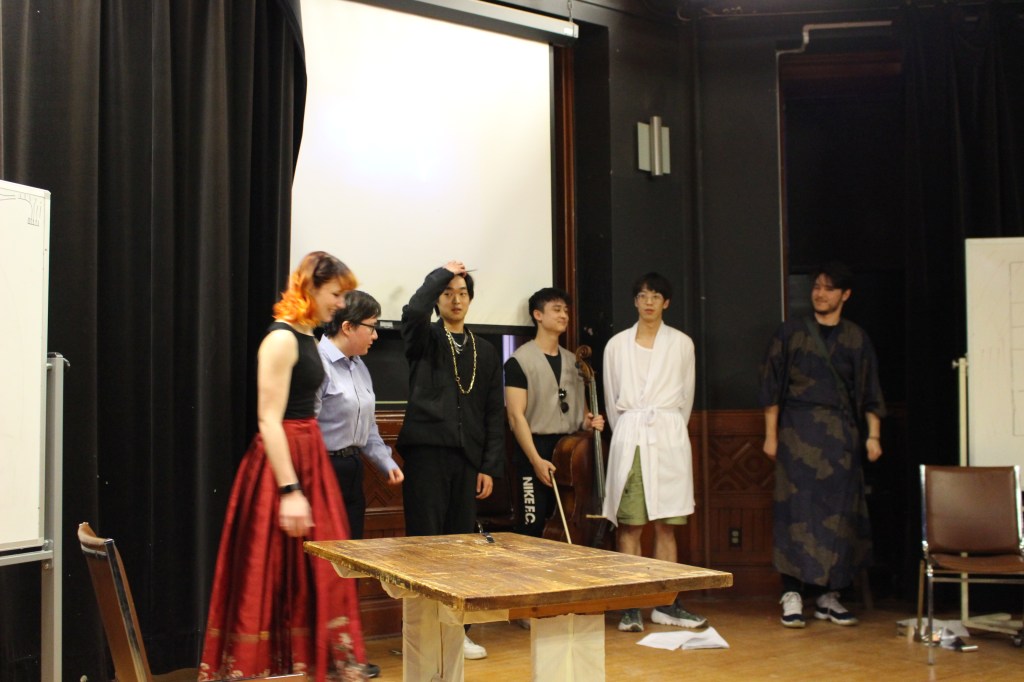
The evening began with a rendition of The Butterfly Lovers, performed by Grace van Bever, Lydia Zheng, Brandon Sun, Lukas Lorenz, and Haohan Li. Originating from the Tang dynasty, although set in the Eastern Jin, the tale highlights the forbidden love between Liang Shanbo, a young scholar, and Zhu Yingtai, a wealthy woman disguised as a man to seek education. Their strong affinity, which first blossomed while studying together but turned into love upon Liang visiting Zhu at her home, reveals societal and familial expectations as Zhu is forced into an arranged marriage. As a result, this then leads Liang to die of a broken heart. However, their love proves to be stronger than these imposed barriers since, in death, as Zhu commits suicide to join the scholar, their spirits transform into a pair of butterflies that are forever united in the afterlife. Overall, with the addition and apparition of a prophet monk, who claims that Zhu is a vessel of immortality whose actions transcend the laws of the mortal realm. The students’ performance was adapted with a comedic modern flair to capture the essence of the original narrative while still infusing it with contemporary elements and humor.
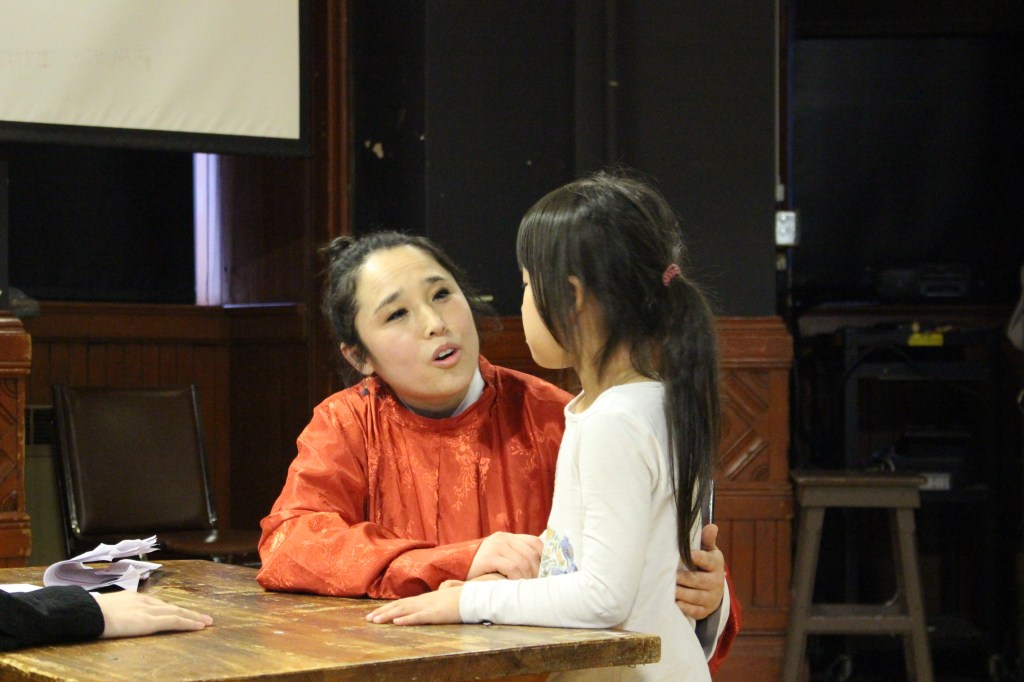
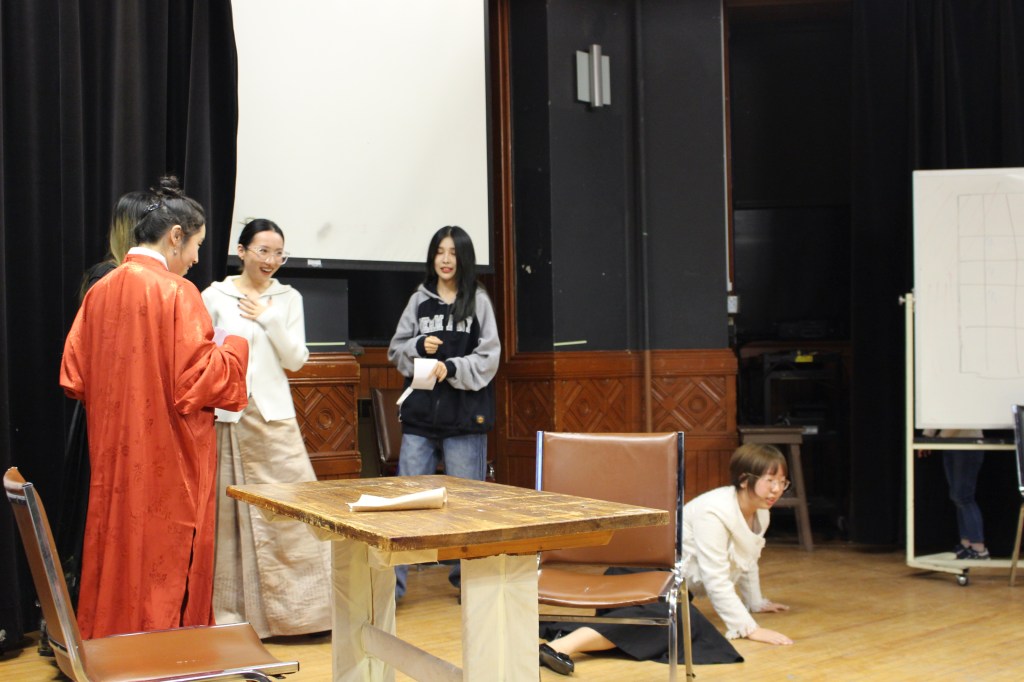
Following this opening act, an adaptation of The Injustice to Dou E was presented by Carolyn Liu, Xinxin Lian, Yuanzhen Shao, Yvette Ran, and Juan Zhang. This rendition drew inspiration from Zhang Maozun’s reinterpretation of Dou E and centered on the portrayal of Zhang as a Ming scholar. Going back in time to the Yuan dynasty after accidentally ingesting an excessive amount of magic mushrooms, Zhang observes a local performing troupe preparing for a Dou E play. The scholar is depicted perplexedly observing the rehearsal while attempting to align the script’s lines with his own beliefs and values. Despite the performance’s focus on the humorous yet intriguing interactions between the scholar and the troupe, it shed light on the intricate themes of loyalty, injustice, societal corruption, sacrifice, and vengeance inherent in the original 13th-century play.

The third act, The Orphan of Zhao, was adapted with a comedic modern approach by Akassia Molina, Thomas Coleman, and François-Xavier Chapdelaine Perreault. The zaju play follows the narrative of Zhao Dun, a nobleman falsely accused of treason, and explores the themes of loyalty, sacrifice, and vengeance. In order to preserve his family’s honour, Zhao secretly entrusted his newborn son to Cheng Ying, a devoted servant, before sacrificing himself. Upon learning the truth about his lineage, Cheng Bo, the orphan raised under Cheng’s care, resolves to seek retribution for his family’s demise. Altogether, despite the complexity of the original plot, the students skillfully intertwined traditional elements with creative ideas and accessories, engaging with and transporting the audience to ancient China.
As the night progressed and transitioned to the early 20th century, the audience was treated to an interpretation of Chen Kaige’s film Farewell My Concubine, performed by Ella Yu,


Shelley Zhong, and Yanou Li. While the play covers several decades and events, including the Japanese invasion and the Cultural Revolution, it follows the lives of Douzi and Shitou, two performers trained at an all-boys Peking opera troupe from a young age. As the play unfolds, their professional and personal lives become entwined with the themes of love, loyalty, sacrifice, and political turmoil. With meticulous attention to detail, the performance wonderfully expressed the emotions and focal points behind the plot, leaving a lasting impression on the spectators.

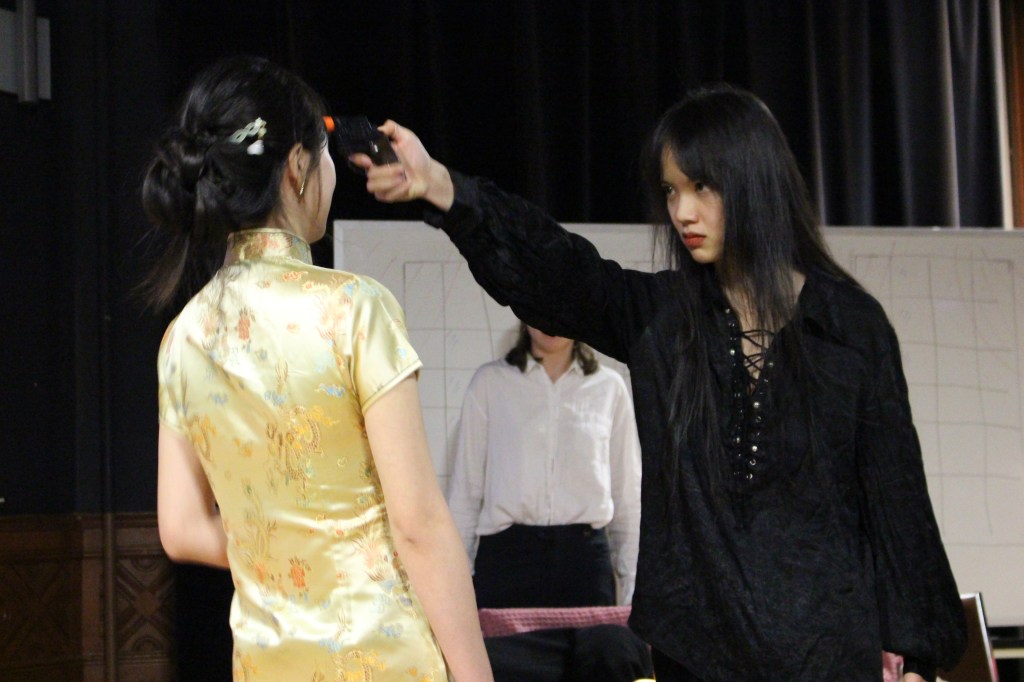

The evening came to an end with an adaptation of Cao Yu’s Thunderstorm, a creative work of modern Chinese drama, also known as huaju. Performed by Yupeng Wang, Meifan Qian, Yilin Liu, Atlas Yanovsky, Keva Misata, Morgan MacEachern, Wyn Lumley, Ziteng Yin, Susan Huang, Ian Zou, and Jasmine Wang, the students exposed the dark secrets of dysfunctionality, betrayal, and illicit affairs revolving around the Zhou family. While focusing on the play’s fourth act, the performance not only revealed the tragic consequences of the characters’ actions from the original play but introduced new and shocking repercussions, including the emergence of new relationships and the demise of several characters. Through the creative staging and compelling character portrayals, in addition to a ghost narrator, the adaptation brought a fresh and new perspective into this timeless classic, eliciting profound emotions and laughter from the audience.
Each performance showcased at the Morrice Hall Tuesday Night Cafe Theater underscored Chinese drama’s lasting significance and broad appeal. By reimagining the narratives of The Butterfly Lovers, The Injustice to Dou E, The Orphan of Zhao, Farewell My Concubine, and Thunderstorm for a contemporary audience, the students not only demonstrated their creativity and talent but also sparked meaningful conversations about tradition and innovation.
Undoubtedly, the event was more than a display of theatrical ability; it was a vibrant celebration of artistic expression and cultural heritage. Through their adaptations, the students of EAST 303 Chinese Drama: 13th to 20th Centuries took the audience on a fascinating journey through time and tradition, leaving a memorable impression on those fortunate enough to attend.

