Author Archives: Guojun Wang
Book Manuscript Workshop
I am extremely grateful to Stephen West, Mark Stevenson, Andrea Goldman, and Tracy Miller, who discussed my book manuscript on costuming in early Qing drama at Nashville on June 1, 2017!
The encouraging and insightful comments will definitely help the book materialize!
Historicizing Spectacle–presentation at 2017 ATHE Las Vegas
Panel: “Embodied Spectacles: Poses, Costumes, and Voices in Asian Theater”
Through the bodily dimension, this panel explores the relation between theatrical spectacles and some significant social-political, gender, and linguistic issues in pre-modern and modern Asia.
8/4/2017 7:30-9:00 PM

My paper: “Historicizing Spectacle: Clothing and Costuming in Seventeenth-century Chinese Drama”
Abstract: Spectacle has generally been defined as the public display of things, which is based on a spatial relationship of viewing and being viewed. This paper challenges the spatial understanding of spectacle by discussing the historical dimension of the sartorial landscape in the seventeenth-century China. During the Manchu invasion into central China around the mid-seventeenth century, the Manchu rulers forced male Han Chinese to shave their heads and change into Manchu clothing. Meanwhile, they allowed the use of Han clothing to continue in drama performances. The Manchu hair and dress regulations produced a sartorial landscape divided by the stage: off stage, Manchu clothing prevailed; on stage, costumes in the Han style remained and Manchu clothing became a taboo. In addition to the stage, drama scripts and visual materials further complicated the sartorial landscape by introducing different modes to represent clothing. Consequently, clothing and costuming in the seventeenth-century China together created a sartorial spectacle which mediated the negotiations between ethnicities, genders, and political powers. Through examining a body of theatrical materials (scripts, illustrations, performance records) in the seventeenth-century China, this paper argues that theatrical the spectacle is inherently historical: it is a “historical effect” rather than the mise-en-scène of a play.
Exhibit: Romancing the Nation in Modern Chinese Literature (2017 Spring)
My 2017 spring course, Romancing the Nation in Modern Chinese Literature, ended with an exhibit of student projects. They were thoughtful works and it was a rewarding semester!


2017-18 leave on an ACLS postdoc fellowship
A recent Postdoctoral Fellowship from the Henry Luce Foundation/ACLS Program in China Studies will allow me to be on leave during the 2017-18 academic year. I will be based in Nashville to complete my first book on costuming and personhood in the unstageable world that is the early Qing China.
Me: I’m going to be on leave next year and will not offer courses.
My students: Are you going to be on vacation?!
Presentation on Late Qing Train Accidents at 2017 Toronto AAS
Title of My Presentation: “Modern Accident: Representing the Sensational Train Wrecks in Late Qing China”
Title of Panel: Technologies of the Modern: Space, Vision, and Power in China
Panel Scheduled Day/Time*: Sat, March 18 8:30am to 10:30am, Sheraton Centre Toronto Hotel, Davenport

Upcoming presentation at MLA on costuming and chastity in the Qing China
I’ll be presenting a chapter of my book manuscript at the 2017 MLA annual convention in Philadelphia. Below is the info about the panel and my presentation:
Session 755. Bodies, Clothing, and Spaces in Early Modern China
12:00 noon+1:15 p.m. on 08-JAN-17 in 410, Philadelphia Marriott.
My presentation:
Seamless Clothing: Boundaries of the Female Body in a Seventeenth-century Chinese Drama
The Manchu invasion into central China in the mid-seventeenth century disrupted traditional gender relations. Chinese drama in this period constituted an especially rich space for representing this disruption. This paper examines the depictions of the female body in an early Qing drama Hai Liefu chuanqi (Chaste Lady Hai). The drama is based on a real event in 1667 when a lady surnamed Hai stitched together her entire outfit to defend against sexual assault before committing suicide. After her death, Lady Hai received public worship from the local community and commendation from the Manchu state. By looking at the drama’s descriptions of the chaste lady’s stitched clothes, her body, her coffin, her statue, and her shrine, the paper argues that women’s socially constructed body became a mediator to reconcile the ethnic conflicts during the dynastic change in the seventeenth-century China.

Imperial commendation of Chaste Lady Hai,
stele 1667, reproduced in woodblock print 1844
Representing the Other in Traditional China
Post election, I changed the paper assignment in my class “Self and Society in Premodern Chinese Literature” to a poster session. The topic is about “the other” in traditional China. The other involves the relation between people of different gender, ethnicity, geographical areas, and involves communications in culture and technology. We hope those in power will have a decent understanding of the diversity of people and culture in our shared world.
Here are a few examples:
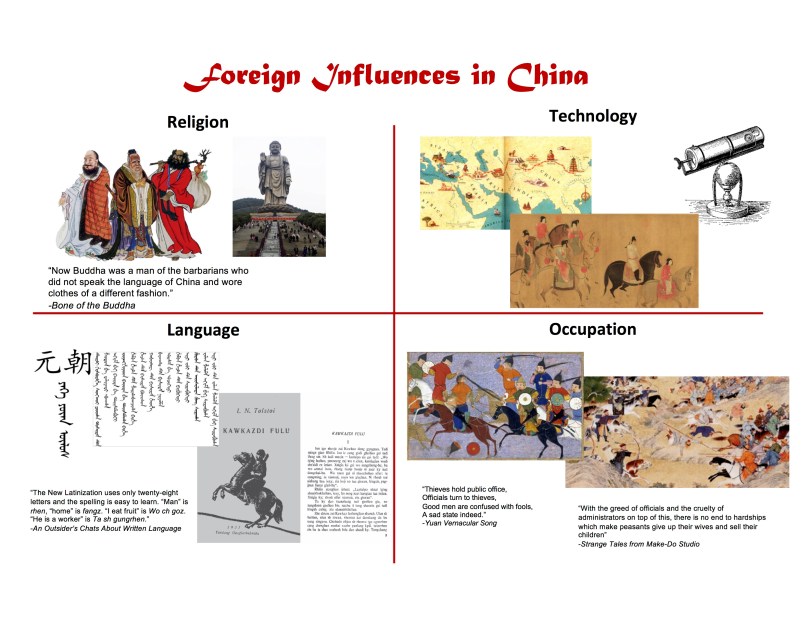
Foreign influence in Chinese history

Resisting the Manchu hair policy during the Ming-Qing transition
Cao Yu’s Thunderstorm in Nashville
I was so impressed by my students’ recent performance of Cao Yu’s Thunderstorm in class. Since we only had one female student in the group, two boys volunteered to perform Fanyi and Mrs. Lu. I especially liked the use of thunderstorm as background music. It was an intensive 50 minutes. So unforgetable.


Artist Wu Fei at my Chinese drama class
On Dec. 5, we were fortunate to have Fei Wu, the renown musician and singer, to perform Chinese music in my class Chinese Drama. Fei is an expert on Chinese guzheng and is familiar with many Chinese performance genres. In our class, Fei performed a kunqu song from the Peony Pavilion 牡丹亭, a song she composed with sanxian (the three string instrument), Summer Palace 頤和園, and the Manchu chaqu 岔曲.

With Abigail Washburn, Fei just performed at the National Immigrant Integration Conference 2016 in Nashville.
http://www.niic2016.org/blog/from-banjos-to-guzhengs

