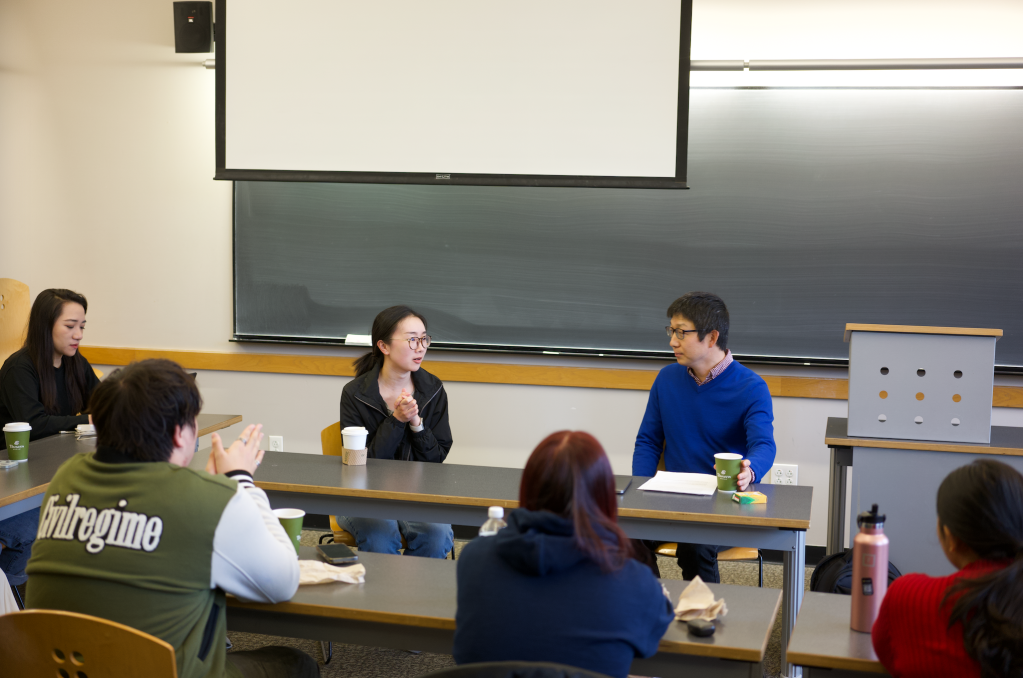
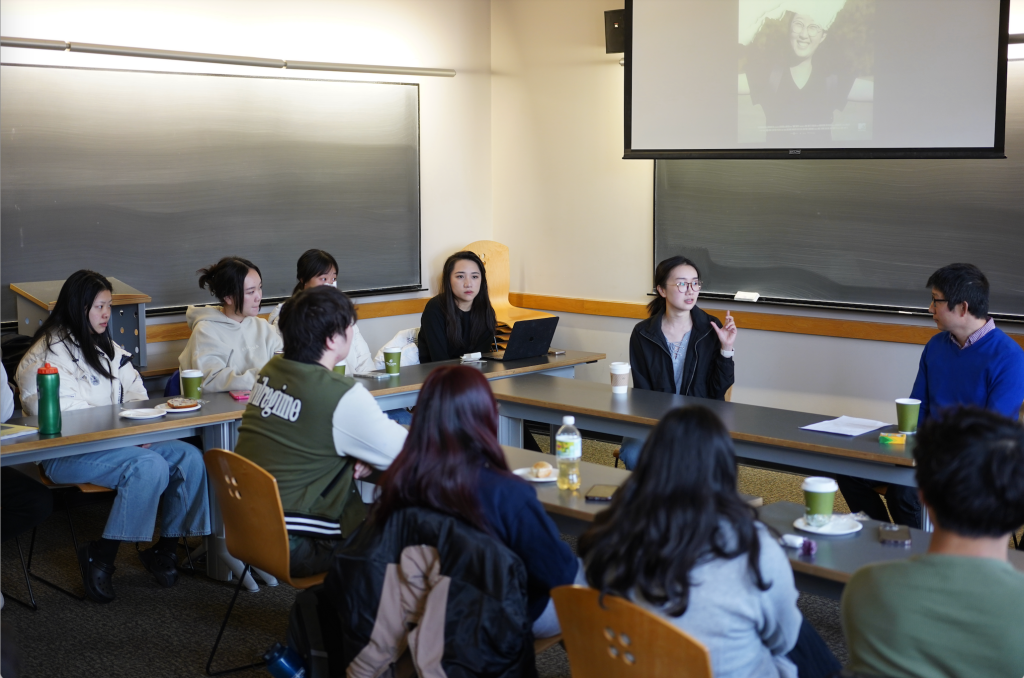
It was my absolute pleasure to host Dr. Yunshuang Zhang’s talk entitled “The Studio in the Mind” at McGill on March 27, 2025. Dr. Zhang shared research from his forthcoming book which studies the scholarly studio 書齋 as a theme and space in Chinese literature, history, and art history, especially the Song dynasty.
Our colleagues and students were not only impressed by the depth of the topic, but also inspired by Dr. Zhang’s effective interdisciplinary approach to her research. More details about the talk can be found here.
Dr. Zhang’s lecture starts a new series entitled “Hsiang Workshop on Chinese Poetics” in the East Asian Studies Department at McGill. We will use this platform to engage with emerging studies on Chinese poetics and the local communities in McGill and Montreal that are connected through classical Chinese poetry.
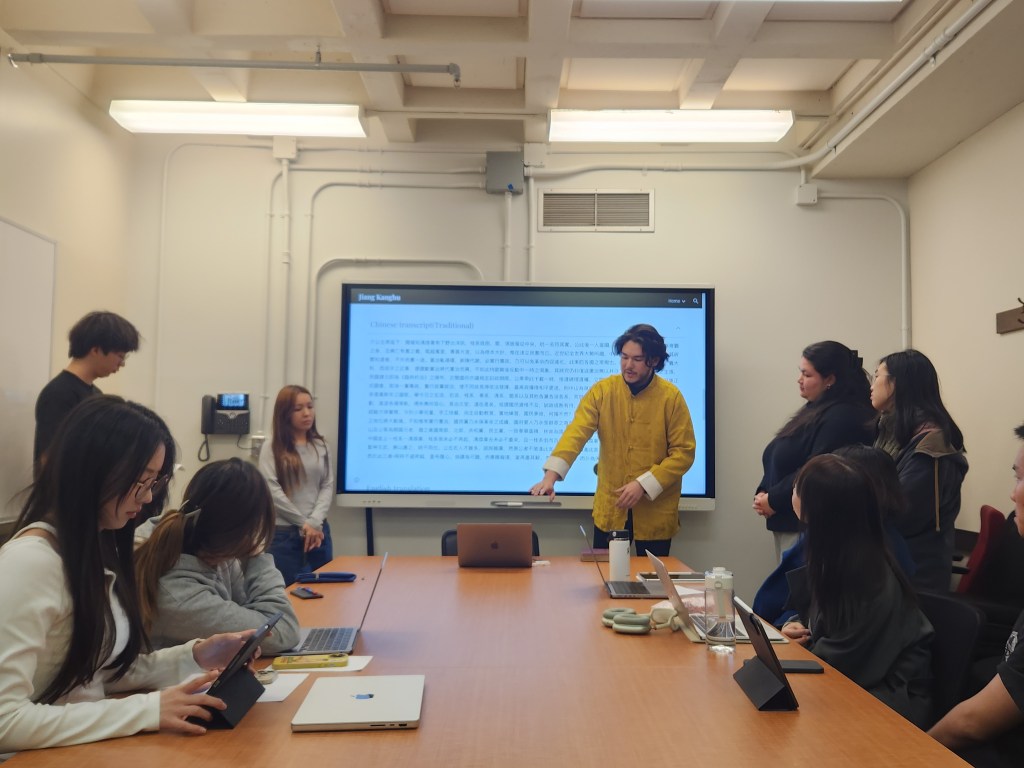
In the fall semester of 2024, I taught Classical Chinese at McGill. It was a small class—just 13 undergraduates—but with a wonderful mix of students from around the world, including China, the U.S., Canada, and Europe. We used Michael Fuller’s textbook as our guide to ancient Chinese texts.
For their final projects, students worked on translating texts written in Classical Chinese from the late imperial and modern periods. These translations were exercises—certainly not ready for publication and undoubtedly in need of revision—but I was thoroughly impressed by the students’ passion and dedication. When given the right guidance, they achieved remarkable progress in such a short time.
The first project focuses on Jiang Kanghu 江亢虎 (Kiang Kang-hu, 1883–1954), who founded the Chinese Department at McGill and taught here from 1930 to 1934. Although he was a prominent thinker and social activist in modern China, his legacy has largely faded into obscurity due to his involvement with the Wang Jingwei government during the Sino-Japanese War. My students concentrated on Jiang’s time at McGill, examining his global connections by analyzing selected letters.
The second project explores the use of Classical Chinese in Montreal’s Chinatown and the more recently developed area near Concordia University. Although we hoped to locate letters written by Chinese immigrants in Montreal, our search was unsuccessful. Nevertheless, the two students working on this project assembled an impressive corpus of materials, uncovering a wealth of topics ripe for further exploration. Their work provides a valuable foundation for future research on the linguistic and cultural history of Montreal’s Chinese community.
The final two projects focus on translations of women writers from Qing-dynasty China. One group worked on selected writings by Xu Yezhao 徐葉昭 (1729–1794), while another student translated the poetry of Yun Zhu 惲珠 (1771–1833). I was deeply impressed by their ability to read and interpret these classical texts. In fact, I was genuinely shocked to learn that one of the students—who grew up in Canada—had never taken a formal Chinese class before.
I would like to especially acknowledge the invaluable assistance of Ms. Hye-jin Juhn, Librarian for East Asian Studies at McGill University. The projects involved in-depth research on premodern Chinese literature and Asian American history. Ms. Juhn not only hosted a workshop on using databases for the class but also created a resource guide for EAST 533: Classical Chinese. Her unwavering support has been indispensable to these and other projects undertaken by my students.
I am also grateful to Ms. Heather McNabb, who helped my students arrange a visit to view selections from the McCord Museum’s collections on Chinese immigrants in Montreal.
This course has been a successful and memorable experiment. I plan to offer it every year and try out new things with different groups of students.
On August 24, 2009, while traveling on an airplane to New Haven CT to start my PhD study at Yale, I was reading a copy of the Hsiang Lectures on Chinese Poetry (vol. 4). Looking outside the window, I wrote down four words on the first page of the journal 凍雲如雪. I had never imagined that fifteen years later I would join the East Asian Studies department at McGill and coordinate the very Hsiang Lectures series.
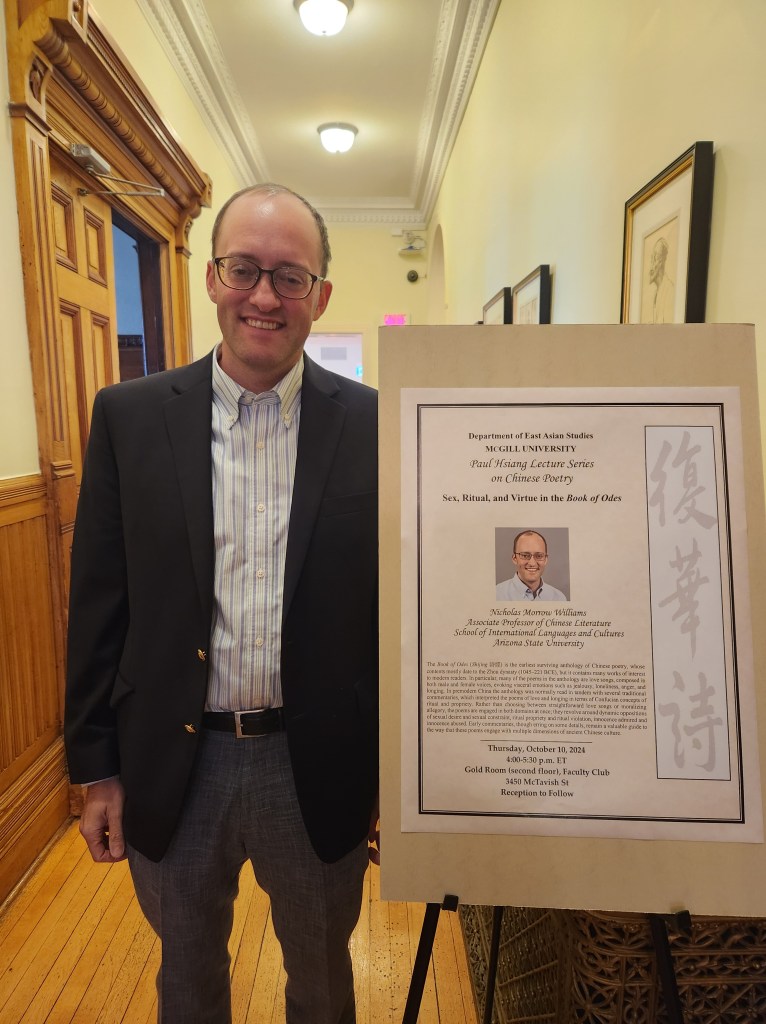
This September 2024, I had the pleasure of hosting my longtime friend, Dr. Nicholas Williams of Arizona State University, for the 2024 Hsiang Lecture on Chinese Poetry. In his lecture, Dr. Williams examined the Classics of Poetry (詩經), challenging the traditional interpretation of certain love poems as political allegories.
Dr. Williams and I met at Beijing Normal University in 2003, when I was an undergraduate student and he was a visiting student from the U.S. We enjoyed a shared love for classical Chinese poetry, especially those from the Han and Six Dynasties 漢魏六朝. We chatted about pursuing PhD studies on Chinese literature in the U.S. Over the years, our paths have crossed in various places, including New York City, Hong Kong, and numerous AAS conferences, where he regularly participates as the editor of the renowned journal Tang Studies. Now, two decades later, we were fortunate to continue our conversation on Chinese poetry in Montreal.
It is only appropriate to record such as rare reunion with poetry, and I think of two:
After working at Vanderbilt University (Nashville, TN USA) for eight years (2015-2023), I left Vandy to join the Department of East Asian Studies at McGill University (Montreal, Canada) during last summer. It was difficult to bid farewell to the great colleagues I’ve worked with at Vandy, but my family decided to reunite at a place where we can all work, study, and live together.
As with any international move, the past year has been exciting with all the promises and challenges. I have found Montreal to be a peaceful, diverse, and reassuring city, a place one can consider calling home. It takes time to learn about the institutions and local cultures, especially the four centuries of Quebec history and the ongoing negotiations among different linguistic communities. But overall I feel privileged to challenge myself with adjusting to a new country and new culture in the 4th decade of my life.
Recently I was named the Richard Charles & Esther Yewpick Lee Chair in Chinese Cultural Studies in the EAS department at McGill. It is truly an honor. In the EAS department, I will teach courses on a range of topics involving Chinese drama, martial culture, gender, crime literature, and Asian diaspora. I will coordinate the Paul Hsiang Lecture Series on Chinese Poetry, and I will be happy to advise prospective MA and PhD students.
In recent years our family have developed a tradition of writing new year couplets to commemorate our ever-shifting life. This is a belated post and I would like to end it with our couplet for the year of dragon:
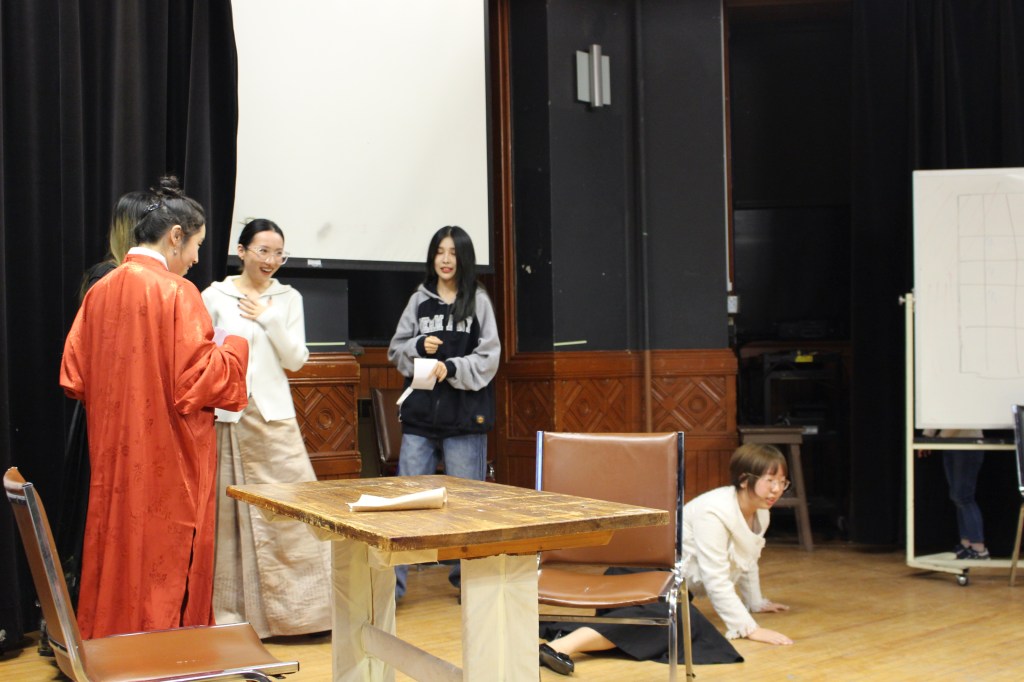
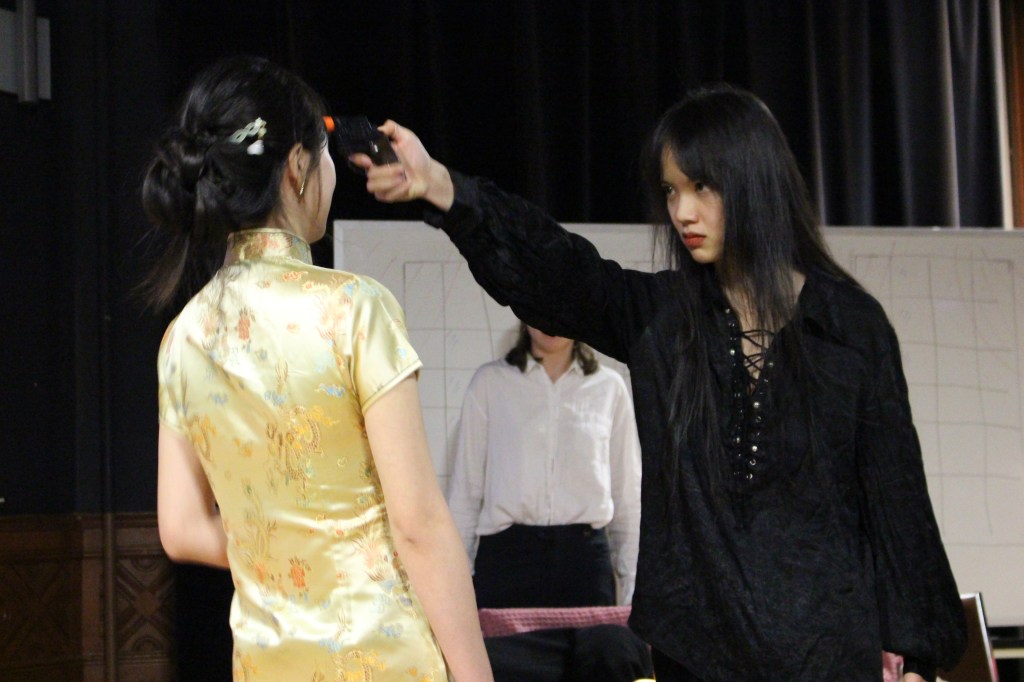
When I teach Chinese drama, I almost always give students the options of writing a paper or perform in a play. I have consistently realized that most students prefer to perform onstage: it is fun, it is memorable, and it is a special college experience.
It took me a while to get used to the McGill way of naming semesters––the fall semester (Sept-Dec) followed by the winter semester (Jan-April). No, there is no spring, not before the regular semester ends. I was not sure if I could find a venue and if the McGill students would be able to pull off a performance event in a number of weeks. With advice from colleagues (esp. Dr. Erin Hurley from English) and support from the Tuesday Night Cafe theater, we did it!
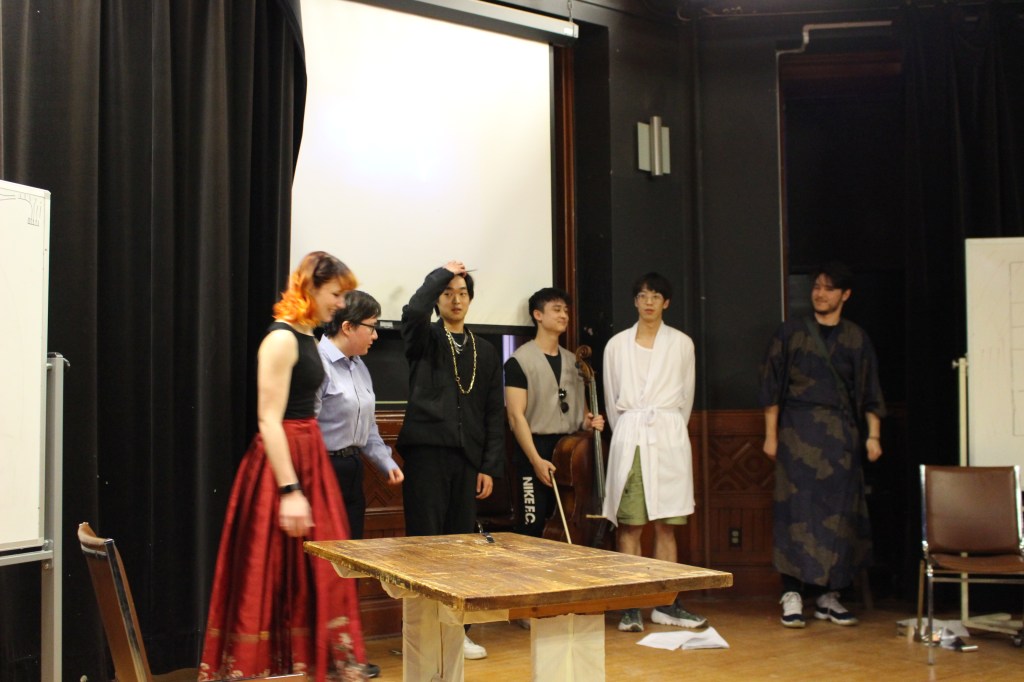
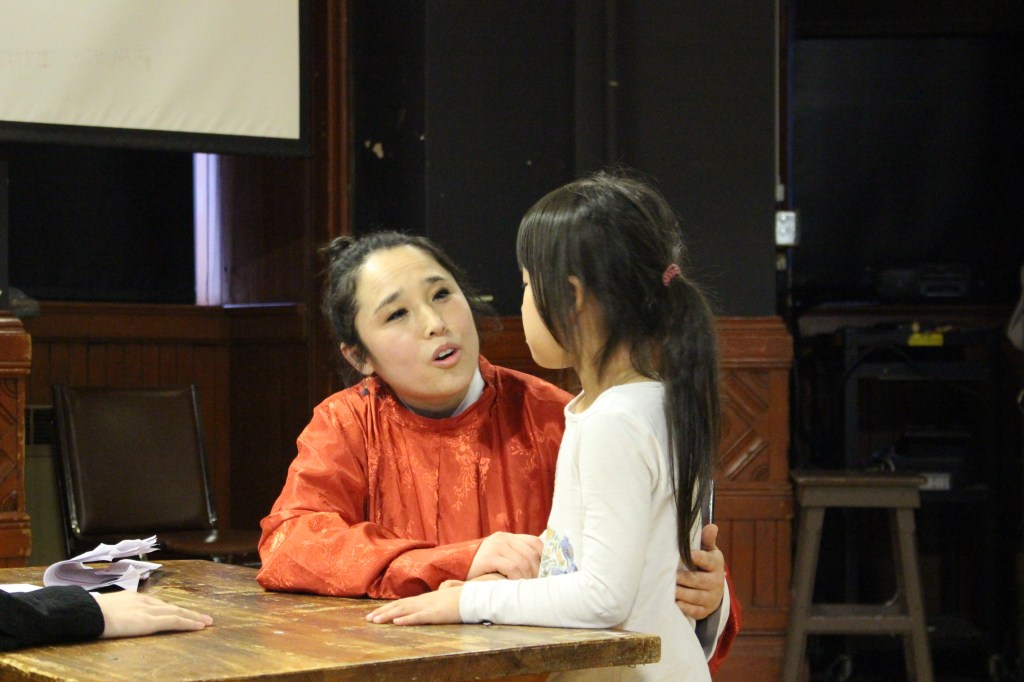
We had $0 budget, so students had to improvise. Some cut up sheets for costumes; others brought their musician friends (and a child) as guest actors. I was thoroughly impressed by the creativity of McGill students. I was indeed a memorable spring, one of many yet to come.
Below is a brief summary of the program done by a student in the class.
Exploring Chinese Dramas: A Night of Adaptation and Entertainment
by Katherine Marchand
On Monday, April 8, 2024, the Morrice Hall Tuesday Night Cafe Theater witnessed an enchanting exhibition of Chinese drama adaptations presented by students from McGill University enrolled in the EAST 303 Chinese Drama: 13th to 20th Centuries course. Five captivating performances, each offering a unique interpretation of classical Chinese dramas, allured the audience and provided insight into the diverse landscape of Chinese theatrical tradition.
The evening began with a rendition of The Butterfly Lovers, performed by Grace van Bever, Lydia Zheng, Brandon Sun, Lukas Lorenz, and Haohan Li. Originating from the Tang dynasty, although set in the Eastern Jin, the tale highlights the forbidden love between Liang Shanbo, a young scholar, and Zhu Yingtai, a wealthy woman disguised as a man to seek education. Their strong affinity, which first blossomed while studying together but turned into love upon Liang visiting Zhu at her home, reveals societal and familial expectations as Zhu is forced into an arranged marriage. As a result, this then leads Liang to die of a broken heart. However, their love proves to be stronger than these imposed barriers since, in death, as Zhu commits suicide to join the scholar, their spirits transform into a pair of butterflies that are forever united in the afterlife. Overall, with the addition and apparition of a prophet monk, who claims that Zhu is a vessel of immortality whose actions transcend the laws of the mortal realm. The students’ performance was adapted with a comedic modern flair to capture the essence of the original narrative while still infusing it with contemporary elements and humor.
Following this opening act, an adaptation of The Injustice to Dou E was presented by Carolyn Liu, Xinxin Lian, Yuanzhen Shao, Yvette Ran, and Juan Zhang. This rendition drew inspiration from Zhang Maozun’s reinterpretation of Dou E and centered on the portrayal of Zhang as a Ming scholar. Going back in time to the Yuan dynasty after accidentally ingesting an excessive amount of magic mushrooms, Zhang observes a local performing troupe preparing for a Dou E play. The scholar is depicted perplexedly observing the rehearsal while attempting to align the script’s lines with his own beliefs and values. Despite the performance’s focus on the humorous yet intriguing interactions between the scholar and the troupe, it shed light on the intricate themes of loyalty, injustice, societal corruption, sacrifice, and vengeance inherent in the original 13th-century play.
The third act, The Orphan of Zhao, was adapted with a comedic modern approach by Akassia Molina, Thomas Coleman, and François-Xavier Chapdelaine Perreault. The zaju play follows the narrative of Zhao Dun, a nobleman falsely accused of treason, and explores the themes of loyalty, sacrifice, and vengeance. In order to preserve his family’s honour, Zhao secretly entrusted his newborn son to Cheng Ying, a devoted servant, before sacrificing himself. Upon learning the truth about his lineage, Cheng Bo, the orphan raised under Cheng’s care, resolves to seek retribution for his family’s demise. Altogether, despite the complexity of the original plot, the students skillfully intertwined traditional elements with creative ideas and accessories, engaging with and transporting the audience to ancient China. As the night progressed and transitioned to the early 20th century, the audience was treated to an interpretation of Chen Kaige’s film Farewell My Concubine, performed by Ella Yu,
Shelley Zhong, and Yanou Li. While the play covers several decades and events, including the Japanese invasion and the Cultural Revolution, it follows the lives of Douzi and Shitou, two performers trained at an all-boys Peking opera troupe from a young age. As the play unfolds, their professional and personal lives become entwined with the themes of love, loyalty, sacrifice, and political turmoil. With meticulous attention to detail, the performance wonderfully expressed the emotions and focal points behind the plot, leaving a lasting impression on the spectators.
The evening came to an end with an adaptation of Cao Yu’s Thunderstorm, a creative work of modern Chinese drama, also known as huaju. Performed by Yupeng Wang, Meifan Qian, Yilin Liu, Atlas Yanovsky, Keva Misata, Morgan MacEachern, Wyn Lumley, Ziteng Yin, Susan Huang, Ian Zou, and Jasmine Wang, the students exposed the dark secrets of dysfunctionality, betrayal, and illicit affairs revolving around the Zhou family. While focusing on the play’s fourth act, the performance not only revealed the tragic consequences of the characters’ actions from the original play but introduced new and shocking repercussions, including the emergence of new relationships and the demise of several characters. Through the creative staging and compelling character portrayals, in addition to a ghost narrator, the adaptation brought a fresh and new perspective into this timeless classic, eliciting profound emotions and laughter from the audience.
Each performance showcased at the Morrice Hall Tuesday Night Cafe Theater underscored Chinese drama’s lasting significance and broad appeal. By reimagining the narratives of The Butterfly Lovers, The Injustice to Dou E, The Orphan of Zhao, Farewell My Concubine, and Thunderstorm for a contemporary audience, the students not only demonstrated their creativity and talent but also sparked meaningful conversations about tradition and innovation.
Undoubtedly, the event was more than a display of theatrical ability; it was a vibrant celebration of artistic expression and cultural heritage. Through their adaptations, the students of EAST 303 Chinese Drama: 13th to 20th Centuries took the audience on a fascinating journey through time and tradition, leaving a memorable impression on those fortunate enough to attend.
The class happens to include 23 students many of whom are first-year international students. For the final project, we explored the Asian students who came to Vanderbilt University for an education from 1873 to 1923, the first 50 years of Vanderbilt’s history. We have discovered amazing adventures, tragic stories, and thought-provoking life choices in times of national conflict.
This has been a unique course and unique experience. I have witnessed significant and occasionally worrisome changes in the south of America during my eight years as a faculty member at Vanderbilt University. Stories of VU’s Asian alumni from 100 years ago shockingly resemble our experiences in modern-day America. I hope students have found my course helpful for them to understand history and navigate today’s troubled world.
During the winter of 2020, in the heat of the presidential election, international students, especially those from China, became easy scapegoats targeted by some mean and malicious politicians in the U.S. I was angry. I was infuriated. I designed and offered a course that I called “Overseas Encounters: Reading the World through Students Abroad”. The subtitle is too long to fit into the registrar catalogue, but I insist on keeping it on my syllabus. This is a course about international students, those to and from U.S., who travers the world and make history.
The 2021 spring course was taught online, with students participating from around the world–thanks to covid. While searching for materials for this class, I ran into the documentary about Finding Yingying directed by Jenny Shi. My students watched the movie and had a virtual conversation with Jenny.
Two weeks ago, in the spring of 2023, Jenny visited Vanderbilt and met with my students in the Overseas Encounters class. It’s such a powerful movie; Yingying’s dead body was not found, but Yingying is discovered and remembered by all of us thanks to Jenny’s courageous work.
Students in my class shared their experiences of accepting rides from strangers in the U.S., about the challenges related to languages, religions, and ideas about race and gender. One student who transferred from UIUC talked about passing by Yingying’s tombstone on the roadside every day.
I also recall that, fourteen years ago, I borrowed money from my former college roommate to buy a one-way ticket to attend graduate school in the U.S. It’s been more than a decade. Now we encounter each other in this classroom, former and current international students.
Thanks so much to Jenny Shi for producing this documentary and for visiting Vanderbilt and my class. We are trivial beings; but we are all significant enough to be known and remembered.
A special issue for The Journal of Chinese Literature and Culture co-edited by Grace S. Fong and myself is now in press and scheduled to come out in April 2023. It’s been such a rewarding experience to work with the great colleagues who contributed to this project! Please find the TOC of this special issue below.
I’m glad that Trans-Pacific Links: The Vanderbilt Asian Alumni Project is among the first group of projects to receive a Vanderbilt University Sesquicentennial Grant ($50,000, 2022-2024). The Trans-Pacific Links project aims to uncover the history and stories of Vanderbilt University’s Asian alumni and the university’s linkage with Asia. The project will involve Vanderbilt undergraduate and graduate students, faculty members in Asian Studies, as well as librarians and staff.
As a first step, students in my class ASIA 2610 Overseas Encounters will work in groups to track down Asian students who came to study at Vanderbilt since the late 19th century, including Charlie Soong (China) and Yun Chi-ho (Korea), among others. It will involve archival work, field work, interviews, and website building.
The project will be co-directed by my colleague Gerald Figal and myself.









 GUOJUN WANG