Hsiang Workshop on Chinese Poetics: Studio in the Mind by Dr. Yunshuang Zhang

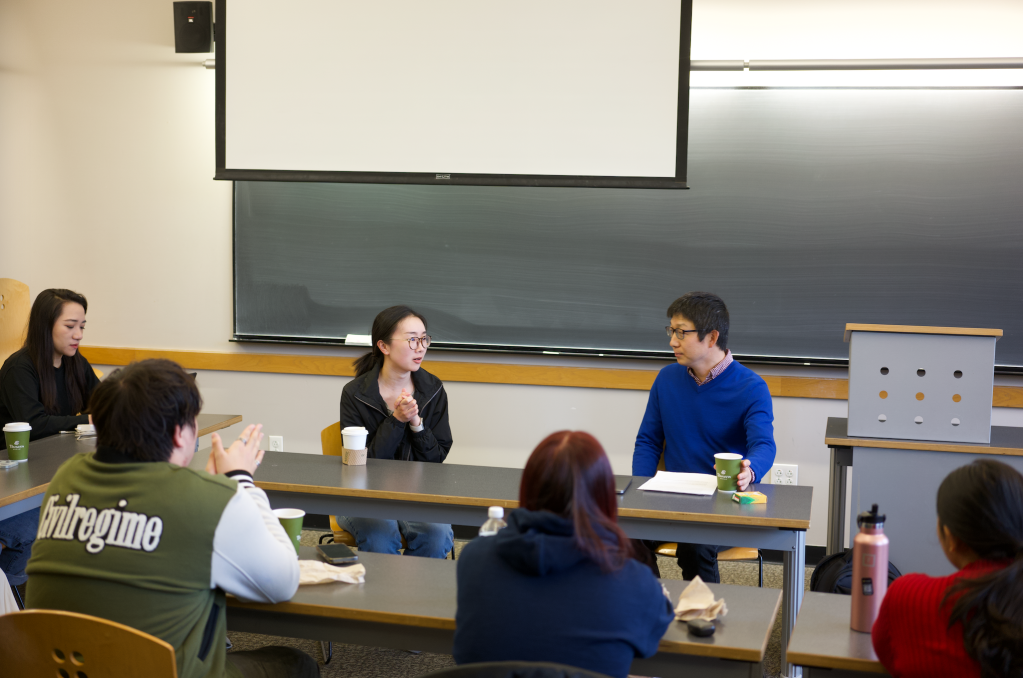
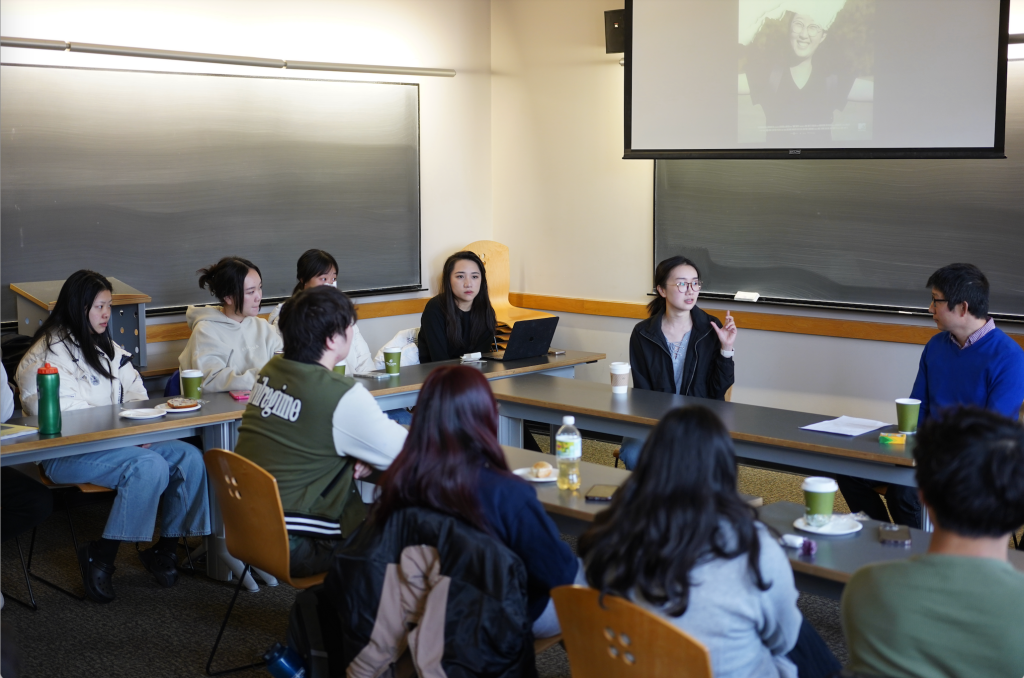
It was my absolute pleasure to host Dr. Yunshuang Zhang’s talk entitled “The Studio in the Mind” at McGill on March 27, 2025. Dr. Zhang shared research from his forthcoming book which studies the scholarly studio 書齋 as a theme and space in Chinese literature, history, and art history, especially the Song dynasty.

Our colleagues and students were not only impressed by the depth of the topic, but also inspired by Dr. Zhang’s effective interdisciplinary approach to her research. More details about the talk can be found here.

Dr. Zhang’s lecture starts a new series entitled “Hsiang Workshop on Chinese Poetics” in the East Asian Studies Department at McGill. We will use this platform to engage with emerging studies on Chinese poetics and the local communities in McGill and Montreal that are connected through classical Chinese poetry.
2024 Hsiang Lecture—a Poetic Reunion

On August 24, 2009, while traveling on an airplane to New Haven CT to start my PhD study at Yale, I was reading a copy of the Hsiang Lectures on Chinese Poetry (vol. 4). Looking outside the window, I wrote down four words on the first page of the journal 凍雲如雪. I had never imagined that fifteen years later I would join the East Asian Studies department at McGill and coordinate the very Hsiang Lectures series.

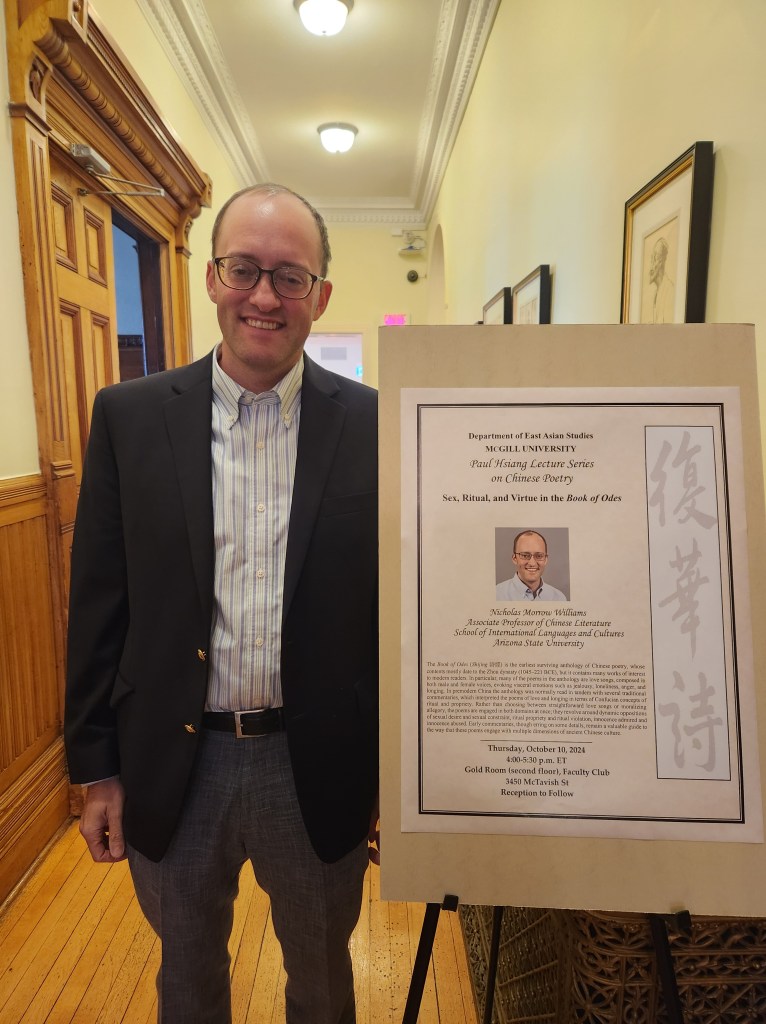
This September 2024, I had the pleasure of hosting my longtime friend, Dr. Nicholas Williams of Arizona State University, for the 2024 Hsiang Lecture on Chinese Poetry. In his lecture, Dr. Williams examined the Classics of Poetry (詩經), challenging the traditional interpretation of certain love poems as political allegories.

Dr. Williams and I met at Beijing Normal University in 2003, when I was an undergraduate student and he was a visiting student from the U.S. We enjoyed a shared love for classical Chinese poetry, especially those from the Han and Six Dynasties 漢魏六朝. We chatted about pursuing PhD studies on Chinese literature in the U.S. Over the years, our paths have crossed in various places, including New York City, Hong Kong, and numerous AAS conferences, where he regularly participates as the editor of the renowned journal Tang Studies. Now, two decades later, we were fortunate to continue our conversation on Chinese poetry in Montreal.

It is only appropriate to record such as rare reunion with poetry, and I think of two:

No.1 杜甫 “贈衛八處士”:
人生不相見,動如參與商。
今夕復何夕,共此燈燭光。。。。

No. 2 黃庭堅 “寄黃幾復”:
我居北海君南海,寄雁傳書謝不能。
桃李春風一杯酒,江湖夜雨十年燈。。。。

I hope the Hsiang Lectures will continue to foster poetic conversations and connections, across decades, across oceans.

New adventures in Montréal

After working at Vanderbilt University (Nashville, TN USA) for eight years (2015-2023), I left Vandy to join the Department of East Asian Studies at McGill University (Montreal, Canada) during last summer. It was difficult to bid farewell to the great colleagues I’ve worked with at Vandy, but my family decided to reunite at a place where we can all work, study, and live together.

As with any international move, the past year has been exciting with all the promises and challenges. I have found Montreal to be a peaceful, diverse, and reassuring city, a place one can consider calling home. It takes time to learn about the institutions and local cultures, especially the four centuries of Quebec history and the ongoing negotiations among different linguistic communities. But overall I feel privileged to challenge myself with adjusting to a new country and new culture in the 4th decade of my life.

Recently I was named the Richard Charles & Esther Yewpick Lee Chair in Chinese Cultural Studies in the EAS department at McGill. It is truly an honor. In the EAS department, I will teach courses on a range of topics involving Chinese drama, martial culture, gender, crime literature, and Asian diaspora. I will coordinate the Paul Hsiang Lecture Series on Chinese Poetry, and I will be happy to advise prospective MA and PhD students.

In recent years our family have developed a tradition of writing new year couplets to commemorate our ever-shifting life. This is a belated post and I would like to end it with our couplet for the year of dragon:

暮雨初霽朝雲江山勝跡
春華開罷秋實下自成蹊
此間忘言

Ms. Jenny Shi Brings “Finding Yingying” to Vanderbilt

During the winter of 2020, in the heat of the presidential election, international students, especially those from China, became easy scapegoats targeted by some mean and malicious politicians in the U.S. I was angry. I was infuriated. I designed and offered a course that I called “Overseas Encounters: Reading the World through Students Abroad”. The subtitle is too long to fit into the registrar catalogue, but I insist on keeping it on my syllabus. This is a course about international students, those to and from U.S., who travers the world and make history.

The 2021 spring course was taught online, with students participating from around the world–thanks to covid. While searching for materials for this class, I ran into the documentary about Finding Yingying directed by Jenny Shi. My students watched the movie and had a virtual conversation with Jenny.

Two weeks ago, in the spring of 2023, Jenny visited Vanderbilt and met with my students in the Overseas Encounters class. It’s such a powerful movie; Yingying’s dead body was not found, but Yingying is discovered and remembered by all of us thanks to Jenny’s courageous work.

Students in my class shared their experiences of accepting rides from strangers in the U.S., about the challenges related to languages, religions, and ideas about race and gender. One student who transferred from UIUC talked about passing by Yingying’s tombstone on the roadside every day.

I also recall that, fourteen years ago, I borrowed money from my former college roommate to buy a one-way ticket to attend graduate school in the U.S. It’s been more than a decade. Now we encounter each other in this classroom, former and current international students.

Thanks so much to Jenny Shi for producing this documentary and for visiting Vanderbilt and my class. We are trivial beings; but we are all significant enough to be known and remembered.

Grant for Trans-Pacific Links: The Vanderbilt Asian Alumni Project

I’m glad that Trans-Pacific Links: The Vanderbilt Asian Alumni Project is among the first group of projects to receive a Vanderbilt University Sesquicentennial Grant ($50,000, 2022-2024). The Trans-Pacific Links project aims to uncover the history and stories of Vanderbilt University’s Asian alumni and the university’s linkage with Asia. The project will involve Vanderbilt undergraduate and graduate students, faculty members in Asian Studies, as well as librarians and staff.

As a first step, students in my class ASIA 2610 Overseas Encounters will work in groups to track down Asian students who came to study at Vanderbilt since the late 19th century, including Charlie Soong (China) and Yun Chi-ho (Korea), among others. It will involve archival work, field work, interviews, and website building.

The project will be co-directed by my colleague Gerald Figal and myself.

The Legend of the Red Lantern

The Legend of the Red Lantern is one of the eight modern operas during the Cultural Revolution (1966-1976). It was based on movies and novels produced in the preceding decades. It was a work of art as well as propaganda for decades in contemporary China. The episode performed by Isaiah Degen features the interrogation of a Communist army member by a Japanese military official. Isaiah innovatively plays both roles by himself.

Peony Pavilion on Zoom

Peony Pavilion is a Chinese opera composed by Tang Xianzu (1550-1616). It is often compared with Romeo and Juliet due to their shared themes of love and death. After discussing part of the drama with a focus on the protagonist Bridal Du’s death caused by lovesickness, a group of students came up with their own ways to dress up and read/perform the encountering in dream between Bridal Du, her lover Student Liu, at the presence of a God of Flowers.

The Orphan of Zhao

The Orphan of Zhao is a canon in the repertoire of classical Chinese drama. Composed by Ji Junxiang during the 13th century, it is arguably the best “tragedy” in premodern China. It was also the first Chinese drama ever translated into European languages.

During the spring semester of 2020, a group of students in US and Asia collectively produced this play on the platform of Zoom. Because most of the could not meet in person, they made the best use of the online platform to present a virtual version of the ancient historical play.