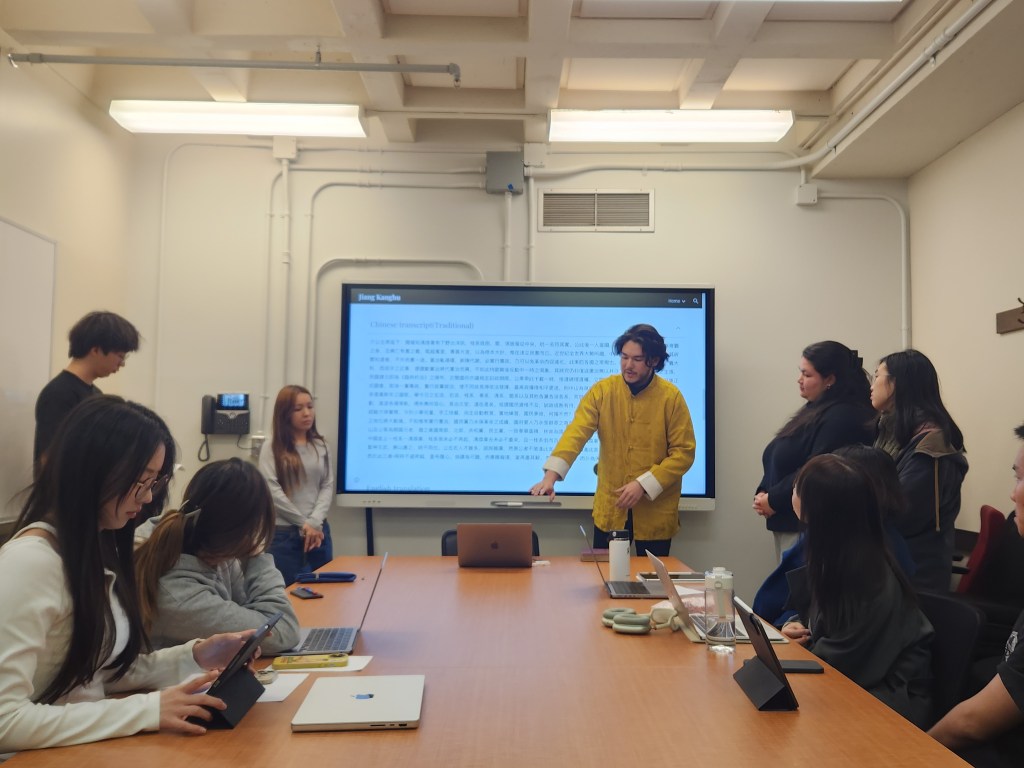
In the fall semester of 2024, I taught Classical Chinese at McGill. It was a small class—just 13 undergraduates—but with a wonderful mix of students from around the world, including China, the U.S., Canada, and Europe. We used Michael Fuller’s textbook as our guide to ancient Chinese texts.
For their final projects, students worked on translating texts written in Classical Chinese from the late imperial and modern periods. These translations were exercises—certainly not ready for publication and undoubtedly in need of revision—but I was thoroughly impressed by the students’ passion and dedication. When given the right guidance, they achieved remarkable progress in such a short time.
The first project focuses on Jiang Kanghu 江亢虎 (Kiang Kang-hu, 1883–1954), who founded the Chinese Department at McGill and taught here from 1930 to 1934. Although he was a prominent thinker and social activist in modern China, his legacy has largely faded into obscurity due to his involvement with the Wang Jingwei government during the Sino-Japanese War. My students concentrated on Jiang’s time at McGill, examining his global connections by analyzing selected letters.
The second project explores the use of Classical Chinese in Montreal’s Chinatown and the more recently developed area near Concordia University. Although we hoped to locate letters written by Chinese immigrants in Montreal, our search was unsuccessful. Nevertheless, the two students working on this project assembled an impressive corpus of materials, uncovering a wealth of topics ripe for further exploration. Their work provides a valuable foundation for future research on the linguistic and cultural history of Montreal’s Chinese community.
The final two projects focus on translations of women writers from Qing-dynasty China. One group worked on selected writings by Xu Yezhao 徐葉昭 (1729–1794), while another student translated the poetry of Yun Zhu 惲珠 (1771–1833). I was deeply impressed by their ability to read and interpret these classical texts. In fact, I was genuinely shocked to learn that one of the students—who grew up in Canada—had never taken a formal Chinese class before.
I would like to especially acknowledge the invaluable assistance of Ms. Hye-jin Juhn, Librarian for East Asian Studies at McGill University. The projects involved in-depth research on premodern Chinese literature and Asian American history. Ms. Juhn not only hosted a workshop on using databases for the class but also created a resource guide for EAST 533: Classical Chinese. Her unwavering support has been indispensable to these and other projects undertaken by my students.
I am also grateful to Ms. Heather McNabb, who helped my students arrange a visit to view selections from the McCord Museum’s collections on Chinese immigrants in Montreal.
This course has been a successful and memorable experiment. I plan to offer it every year and try out new things with different groups of students.
 GUOJUN WANG